Thursday, 14 September 2017

iPhone X vs Galaxy Note 8: Flagship Comparison

           Apple’s flagship iPhone X, priced at $999, is their most expensive smartphone yet, but one can get many of its features at a much lower price in the Galaxy Note 8

Apple iPhone X


        Apple has refreshed its smartphone line-up with three new iPhones. The iPhone 8 and 8 Plus run on the new A11 processor but have the same design language as the iPhone 7 and 7 Plus. It is the iPhone X which is going to get most of the attention with its cutting-edge looks and compact form factor.

        It will be available in India from 3 November at a price tag of Rs89,000 (64GB). The 256GB variant will cost Rs1,02,000.

        Like every year, the new iPhones are going up against some very formidable rivals in the Android ecosystem. Here is how the iPhone X stands in comparison to Samsung Galaxy Note 8, which costs Rs67,900.
The bezel-less screen
New Design

        The standout element in the iPhone X is the bezel-less screen. There are practically no bezels on the front panel, except for a tiny strip for the front camera and the new Face ID sensor. It is this breakthrough design which has allowed Apple to incorporate a 5.8-inch screen in a form factor of a 5-inch screen phone. It is just 143.6mm long, 70.9mm wide and weighs 174g.

        The Galaxy Note 8 has got no vertical bezels either and the horizontal bezels have been reduced to a small strip. It offers a slightly bigger 6.3-inch screen and looks a lot taller (162.5mm), wider (74.8mm) and weighs (195g) more than the Apple iPhone X.

        The new iPhones are protected against dust and water splashes and come with IP67 certification. This means it can tolerate rain but not a dip in swimming pool.

        The Galaxy Note 8 comes with one level higher IP68 rating and can survive water up to a depth of 1.5 metres.

Clearly, Apple scores in terms of ergonomics, but the Note 8 is more durable.


 Battle of big screens 

        The iPhone X comes with a 5.8-inch OLED display which supports 4K HDR, has a resolution of 2,436x1,125p and pixel density of 458 ppi. It’s the biggest screen ever seen in an iPhone but still smaller than the Android rivals. The 6.3-inch display on the Note 8 uses a slightly advanced AMOLED panel and offers a slightly better resolution of 2,960x1,440p and pixel density of 521ppi.
The Note is clearly a better bet for users looking for a big-screen experience.

New processor

        The iPhone X is powered by the new A11 Bionic processor, which Apple claims is 75% faster than the A10 Fusion processor used in last year’s iPhones. The Galaxy Note 8 is driven by Samsung’s proprietary but powerful Exynos 8895 octa-core processor, which is at par with the likes of Qualcomm Snapdragon 835 processor.

        There is no 32GB or 128GB storage option in the iPhones this year. The lower variant of iPhone X has 64 GB storage and the higher variant offers 256GB storage. The Galaxy Note 8 has a single 64GB storage version and it accepts microSD cards of up to 256GB.


Unlocking the phone

        Apple has given the fingerprint scanner a miss in the iPhone X and has used a face recognition-based tool called Face ID. It uses AI (artificial intelligence) and static facial recognition technique to map 30,000 data points on a person’s face and build a unique 3D model.

        The Galaxy Note 8 is better endowed when it comes to security. It has a fingerprint sensor on the back, an Iris scanner and a face recognition scanner on the front.
The Galaxy Note 8 has also got a stylus called S-Pen which can be used for work, drawing and writing on the phone’s screen.

Dual Cameras

        For photo enthusiasts, the iPhone X packs in dual 12-megapixel cameras with OIS in both. The wide-angle lens has an aperture of f/1.8 for better low-light results and the telephoto lens which offers 2x optical zoom has an aperture of f/2.4.

        Samsung rarely misses out on the camera front. It has got two 12-megapixel cameras with OIS on both of them. It has an aperture of f/1.7 and 2x optical zoom.
On paper, they look at par with each other. Real-life results can still vary.

        The iPhone X and Galaxy Note 8 are in a neck-to-neck battle. Galaxy Note 8’s strength lies in its bigger screen which means more legroom for watching movies and playing games. It has also got a stylus called S-Pen which can be used for work, drawing and writing on the phone’s screen.

        The iPhone X is a huge upgrade in the iPhone family. It brings refreshing design, new chipset and bigger screen, but comes at a very hefty price tag. Even the Galaxy Note 8 looks like a bargain next to it.

Monday, 12 September 2016

Android 7.0 Nougat update arrives: will you get it ?

Bored using same Version on your android smart phone?
You Need an update agree?? 

                So Cheers, The New Android 7.0 Nougat update just arrives:

                When will you Get it?? lets take a look about.


Update, August 22: Android 7.0 has arrived.

When Google dropped the Android N developer preview on March 9 it was also pretty open about its update timeline. Google identified five monthly developer previews in advance of the final release of Android 7.0 by the end of September 2016.
 
By getting the first developer preview out earlier this year, Google gave itself a couple of months head start on getting all of the necessary fine-tuning and bug squashing done with plenty of time to spare. 
But it also gave app developers and manufacturers an even earlier look at what to expect from Android 7.0 Nougat and additional time to get the update ball rolling.


Now Android 7.0 has finally landed in its final form, slightly ahead of schedule. 
That just leaves us with the question: when will it hit our devices? 

The answer to this will vary wildly depending on the OEM in question, with the current-gen Nexus devices getting it first.

Latest Android 7.0 news

As previous rumors suggested, Android 7.0 Nougat formally arrived on August 22nd. The latest version doesn’t bring anything notably different from the previous beta, although you can expect that a ton of bugs were squashed in order to bring the most stable experience possible.


Besides the visible stuff though, Google previously teased several tidbits of information about the Android 7.0 Nougat update during Google I/O. For starters, Android 7.0 will introduce seamless updates so future Android updates happen silently in the background via A/B partition switching.
 We’re sure that we’ll find a few other interesting new features and changes that lie under the surface as we dive deeper into Android 7.0 in the weeks to come.


In the meantime, be sure to check out our roundup of key features to get a better look at what’s new.

Tuesday, 24 May 2016

Galaxy S7 Active rumors

Samsung Galaxy S7 Active 

Galaxy S7 Active rumored to pack 4000 mAh battery, Snapdragon 820 and more

A new report claims to have the hardware specs for the still unannounced Samsung Galaxy S7 Active. And if the report is to be believed, the AT&T-bound smartphone will be a bit bulkier than its predecessor while packing a bigger battery and similar screen size.

According to VentureBeat, the thickness of the Galaxy S7 Active will be 9.9mm, compared to the Galaxy S6 Active's thickness of 8.6mm. The S7 Active will also be heavier at 185 grams, compared to just 170 grams for the S6 Active:
"That increase is likely due to the S7 Active's significantly larger battery, whose 4000mAh capacity is almost 15 percent greater than the prior model's 3500mAh pack. However, the bigger dimensions do not house a larger screen, as has been rumored previously about this device; instead, its 5.1-inch, 1440 x 2560-pixel Super AMOLED display is the same as both the Galaxy S7 and Galaxy S6 Active."
The report also claim the S7 Active will have a Qualcomm Snapdragon 820 processor, 4GB of RAM, 32GB of internal storage with a microSD card slot, and a 12 megapixel rear camera with a dual pixel sensor for better low-light images. In addition, it will reportedly have a 5MP front-facing camera. Lastly, this rugged version of the Galaxy S7 may be headed for June 10 launch, according to the report.

Are you planning to pick up the Galaxy S7 Active once it's launched in full? Let us know what you think in the comments!

Courtesy: android central. 

Wednesday, 18 May 2016

Microsoft Surface Phone Rumors: Intel CPU, 12GB RAM, Release Date April 2017


1458577275-12030---Microsoft-Corporations-(MSFT)-Surface-Phone-Rumors-The-Biggest-Flagship-Yet
Microsoft Surface Phone
 When Microsoft abandoned its Lumia series, a number of industry experts thought that the company will not manufacture any new smartphone series. This is because analysts estimated that the Redmond giant is planning to invest additional resources for the upcoming Surface Pro 5. By taking all users in surprise, Microsoft has announced the probable launch of Surface Phone in 2017. Here is what we know so far about Microsoft Surface Phone price, specs and release date.

Surface Phone Release Date and Availability

According to reports coming in, the much-awaited Surface Phone is expected to hit retail stores by April 2017. The delay is due to the fact that Microsoft is looking forward integrating Kaby Lake, which is touted to be the next generation Intel processor.
 Moreover, the upcoming Surface Phone will be equipped with the latest update of Windows 10 Mobile operating system, which will kick off later this year.

Surface Phone Features

We believe that Microsoft is considering to infuse some new technologies, like pen interface and fingerprint sensor into the Surface phone.
Hence, the product team is willing to take more time to build the device, which will incorporate latest features.

If reports are to be believed, the Surface Phone will be released after the official launch of the upcoming flagship hybrid Surface Pro 5, and Surface Book 2 laptop.

Surface Phone Specs

On the specifications front, the upcoming Surface Phone is expected to ship in three variants. While the first variant will be equipped with 4GB RAM/64GB of storage, the second model will be integrated with 6GB RAM/128GB storage.

All of them are expected to bear the new Intel 14nm Koby Lake processor.
Microsoft is also currently building a roadmap for a high-end version of Surface Phone, which will be equipped with 8GB RAM and 512GB storage. There is also a possibility to release a premium model with 12GB RAM.

On the camera segment, the upcoming Surface Phone is expected to be equipped with at least 21MP camera and 8MP front-facing shooter. It is also possible to have different camera specifications depending upon RAM capacity.

Microsoft is expected to integrate 3,000mAh battery in all variants of Surface Phone, although it can change depending upon RAM flavor.

On a less relevant note, according to unconfirmed sources, Microsoft is also rumored to manufacture a signature edition Surface Pro, which will have the signature of Bill Gates.
With support for Microsoft Continuum without a separate dock, Microsoft Surface Pro will be available for consumer and business users separately.


Tuesday, 29 December 2015

iPhone 7, 4-Inch iPhone 6c Details Tipped in New Leaks

iPhone 7, 4-Inch iPhone 6c Details Tipped in New Leaks

A new report out of China has claimed that the new iPhone models will be waterproof, corroborating previous reports. Additionally, the purported specifications of the rumoured 4-inch iPhone 6c have surfaced for the first time on the Internet.
China-based Commercial Times (via DigiTimes) citing a research firm reports that Taiwan-based Catcher Technology will be the largest supplier of metal chassis to Apple for the upcoming iPhone models. Adding further, the report has claimed that Apple will be using a compound material for the upcoming iPhone models that will hide the antenna bands on the phone's body. It added that Catcher Technology supply is expected to account for 30-35 percent of the new iPhone shipments.
Talking about overall industry, the report suggested that demand for metal chassis from other companies will account for 40 percent in the first half of 2016.
In separate news, Chinese blog My Drivers has claimed some of the innards of the much-anticipated 4-inch iPhone 6c (also rumoured to be called the iPhone 7c) citing supply chain sources.
Some of the specifications tipped include a 1642mAh battery, which is comes out to be true will be bigger than the battery seen on previous 4-inch iPhone 5c. Other details rumoured for the iPhone 6c include an A9 processor, 16GB of inbuilt storage, Touch ID, and 2GB of RAM.
A recent report had suggested that Apple may unveil its 4-inch iPhone 6c model in April citing a leakedChina Mobile 2016 phone roadmap. The launch month falls in line with the previous rumours that indicate a mid-2016 launch of the 4-inch iPhone.
Based on preliminary leaks, Apple is said to consider ditching the Lightning connector and replace it with a USB Type-C port. Some other features that Apple is rumoured to be working on include multi-touch 3D Touch, dual camera sensors, and an in-display fingerprint recognition technology. An earlier report also claimed that Apple may ditch the 3.5mm headphone jack from the iPhone in favour of Lightning connector-enabled earphones and adapters.

Thursday, 29 October 2015

Apple Fans to Get Their Hands on New Apple TV This Week


 apple-tv

Apple on Monday opened up advanced orders for the next generation of Apple TV, as promised. The set-top boxes are expected to hit homes between Oct. 30 and Nov. 3.
It's offering two versions of the Apple TV. A 32-GB version is priced at US$149 and a 64-GB model is $50 more.

The features most likely to stand out are voice control with Siri, apps, and the range of content that Apple has and will continue to assemble.
With Apple TV losing ground to newcomers to the streaming hardware market, namely Google and Amazon, the company has revisited its set-top box and given it a booster shot: a syringe containing Siri.

Siri, Apple's digital assistant, manifests in the form of the Apple TV's companion remote. It's the same helpful, politely realistic digital assistant iOS users have become familiar with over the years.
Along with Siri, the remote has been updated to include motion controls akin to Wii nunchucks. That led to speculation that Apple and Nintendo were preparing to start a gaming relationship.
While nothing with Nintendo has been announced, the other draw to Apple's latest streaming device is content, said Andy Abramson, CEO of Comunicano.

Then there's "same day as DVD releases, which underscores the arms race going on between Apple, Amazon and eventually Google," he told TechNewsWorld.

"Obviously, games also are going to have a lot of appeal, as they open up the Apple TV to be something for the entire family," Abramson said.

The market for streaming media hardware has filled out in short order over the last few years, expanding from Roku, the original Netflix player and Apple TV to Chrome and Fire and Nexus things.

Ahead of this latest refresh of the Apple TV, bringing it to its fourth generation, the company was rumored to be in talks with some of Hollywood's top brass, with hopes of delivering original content like Amazon and Google do. 

Playing Catch-Up

With Siri being one of a few serious talking points for the Apple TV, Robert McCarthy, director of security engineering at Mobiquity, is unimpressed by the new set-top box.

"Color me disappointed," he told TechNewsWorld. "Maybe it's just me, but I see this as nothing but Apple being caught sleeping and now trying to play catch-up with the market."

It's going to have voice controls and a lot more games, but Amazon Fire TV has had that from the beginning, McCarthy pointed out. With accelerometers in countless smart things, the motion controls may fail to strike consumers as a stand-out feature.

"Overall, I think the new Apple TV fails to capture some of the revolutionary power that is happening with Apple Pay and iPhone 6S, and could readily be relegated to the bells and whistles bin," he said. "All in all, this feels just like your father's set-top box." 

Missed Opportunities

Adding to his lack of interest are the things Apple TV is lacking, McCarthy said. For one, it doesn't support 4K resolution or high-dynamic-range imaging.

"Although it might not technically make much of a difference, from a marketing standpoint, the lack of 4K or HDR video support is confusing," he said. "The latest iPhones are producers of 4K video. Why is the latest TV product not a consumer of it?"

There also isn't any HomeKit integration, said McCarthy. That could tie into another area in which where Apple may have missed countless opportunities.

"A big chunk of their developer community may never work in this arena because they created yet another OS, called tvOS, that is a hybrid between OS X and iOS. I am sure there are reasons they had to do this, but it seems odd and will likely drive a further wedge into the developer community," he said.

Though the latest flavor of Apple's streaming hardware hasn't thrilled McCarthy, at least in the device's current form, it's hard to discount the "cult of Apple." 

The Faithful: More Than a Few

Despite Apple's roped-off ecosystem, its new products historically have called consumers over from other platforms and, on many occasions, they've been converted to the cult.

"That's part of the Apple way of doing business," Comunicano's Abram-son said. "If you look at what they did in music with the iPod, then in phones with the iPhone, how they are slowly changing the timekeeping world with the Apple Watch, with each new product they release, they redefine and become the comparative standard."

Because viewing habits have been changing, the appeal of the Apple TV will extend beyond consumers, he said. It will have an impact on the entire television industry, further forcing the hands of the established players.

"That's a lesson that is easily learned based on how iTunes changed the music industry," said Abramson, "and how the iPhone has changed the mobile phone and mobile operator industry."


Thursday, 10 September 2015

iPhone 6S brings touch-sensitive screen, sharper camera, faster touch sensor.

Apple’s September 9 event was jam-packed with cool new products and features, but the headliner of the the event was the iPhone 6S and iPhone 6S Plus launch. Here’s everything you need to know about the new iPhones.

A 12-megapixel camera with 4K video

The iPhone 6S’s camera finally got a huge upgrade with a 12-megapixel iSight camera and a two-tone flash. The increase in pixels improves the detail in photos, but Apple claims that image quality won’t be degraded thanks to new technology like “deep trench isolation,” which separates the photo diodes to maintain accurate colors and limit noise. The sensor has 50 percent more pixels as well as 50 percent more focus pixels to make auto focus faster.
The company showed off a number of incredible images taken with the iPhone 6S, and assured the crowd that none were retouched. A new panorama shot shows off how much bigger the panoramas can be, too. The iPhone 6S can now shoot 4K video, too — though you won’t be able to appreciate all the extra pixels viewing videos on the phone’s sub-4K screen.

http://icdn2.digitaltrends.com/image/iphone-6s-camera_large-640x427-c.jpg 

 Apple showed some love to the selfie cam, too with a 5-megapixel front-facing camera and a “true tone” flash. It lights up the phone’s main display to produce an accurate “flash” that matches the colors the camera sees. That way, the flash doesn’t wash out your face in the selfie.

3D Touch

Apple’s new 3D touch-enabled screen takes multitouch to the next level by adding a third dimension: pressure. It’s sort of like Force Touch on the Apple Watch, but with special features for the iPhone and different levels of pressure. Apple calls it “3D Touch.” A light press on the screen will bring up a preview of content, whether it be an image, a website, or an itinerary. If you keep pressing, you’ll enter the content you selected. It allows you to dip in and out of where you are without losing context. The background of the app you’re in blurs out a bit, so you can see a preview on top.
According to Apple, you won’t have to jam down on the screen like you do on the Apple Watch; just a small bit of pressure can be registered on the screen, and the phone can tell the difference between mini taps and full taps. Capacitive sensors in the backlight portion of the display measure microscopic changes in distance between the glass and sensors. It also uses the accelerometer to determine pressure levels with more accuracy.

false


Apple showed off a demo of 3D Touch in action with Mail and iMessage apps. You can flick up from the bottom of the screen for actions like send, forward, etc. If the person you’re conversing with mentions a time, a flight plan, or other info, a light tap will bring up your calendar so you can check if you’re free, or show you the flight status.
3D Touch also works with apps on your home screen to bring up quick actions, so if you tap on the phone app, you’ll see your favorite contacts. You don’t have to actually enter the app to access features you use the most. If you tap on the camera, it’ll bring up “emergency selfie” mode. Of course, this mostly works with Apple apps, but some third-party apps will get the feature, including Dropbox, Facebook, WeChat, and Instagram.

Design stays the same

Apple chose to keep the iPhone 6S and 6S Plus’ physical design the same, but now offers a rose gold aluminum finish in addition to the silver, space gray, and gold versions. The new iPhones are made out of the new 7000 series aluminum that was used on the Apple Watch.

Faster A9 processor, Hey Siri, and more

Apple’s iPhone 6S and 6S Plus are powered by the A9 64-bit processor, which boasts a new transistor architecture for better energy efficiency. Apple says it’s 70 percent faster than the A8 at CPU tasks, and 90 percent faster at graphics tasks than the A8. An onboard M9 co-processor is always on to track steps and other fitness metrics. The iPhone 6S and 6S Plus support LTE Advanced, so it should be twice as fast, and Apple supports 23 frequency bands. Wi-Fi is allegedly twice as fast, too.
false

As expected, the Hey Siri feature lets you speak directly to your iPhone without it being plugged in. Just say, “Hey Siri,” and you’re in. The iPhone 6S has a new Touch ID sensor that is “faster than ever,” which should improve the Apple Pay experience greatly.

Price and release date

Apple will sell the iPhone 6S for $200 and the iPhone 6S Plus for $300, with two-year contracts. For carriers with installment plans instead of contracts, typical installments will start at $27 per month for iPhone 6S and $31 per month for the iPhone 6S Plus. Apple also has a new iPhone upgrade program, which nets you a new iPhone every year – for a variable monthly fee. The new phones come out on September 25 in a number of countries. We’ll keep you updated on availability here.


Wednesday, 19 August 2015

10 most iconic mobile phones of all time


iconic-mobile-phones 


Ask people what their favourite phone of all time is and chances are you’ll get a wide variety of answers, with a select few being chosen by many people. Everyone has a particular device they remember, but what devices have defined mobile phones as we know them?

The word iconic has been branded to a lot of different devices and innovations but is there a particular device that has withstood the test of time to remain as iconic as the day it was first released? Here’s 10 phones (some of which you probably know of) that have defined the mobile industry as we know it.


1. Nokia 3310

Nokia 3310


When it comes to mobile phones, very few are as iconic as the Nokia 3310. Simply put – you either had one, or you know someone who had one. In fact, you probably had one – just about everyone had either the Nokia 3310 or its predecessor, the Nokia 3210. These were the phones that made Nokia the mobile phone king.

The handsets brought Nokia’s X press On Covers and the iconic game, Snake (as we know it, with the image of a snake) and permanently changed what we considered to be a mobile phone. Built like a brick with a battery life that people crave today, the Nokia 3310 was the first mobile phone to radicalise an entire industry.


2. Motorola RAZR V3


motorola-razr-v3 


Where the 3310 made Nokia, the RAZR V3 made Motorola. Before the V3, the concept of a slim phone was alien and even the 3210 and 3310 were bricks compared to this ultra-slim metal-clad mobile device.

The design proved so popular that Motorola continued using it for years and not only was it ultra-slim, but it proved that flip phones could be cool. It forced Motorola’s rivals to reconsider what could be possible with mobile design and brought about an era of manufacturers attempting to make sexy smartphones.


3. Nokia N95


Nokia-N95
There’s a pattern here and for good reason; Nokia, Motorola and RIM (now known as BlackBerry) were the undisputed kings of the mobile phone industry. The smartphone industry is an entirely different kettle of fish, as you’ll see below, but the Nokia N95 began defining what it meant to be a flagship smartphone.

Nokia’s N95 takes its place on this list for one reason and one reason alone; it heralded a fiercely contested battle (that still rages today) about mobile cameras and gave birth to an entire market devoted to cameras for mobile devices. Add in the cool design, powerful (for its time) OS and tons of neat tricks, the N95 was another device that sold in the tens of millions and is iconic for so many people.


4. Apple iPhone 3G


iphone-3g


Let’s be completely fair – it wouldn’t be an iconic phones list without the iPhone. However, unlike other lists, we’re not talking about the original Apple iPhone here. In my personal opinion, the iPhone 3G deserves the plaudits, as it fixed a few basic bits of functionality that were missing from the original iPhone and added a feature that defines smartphones: the App Store.
The rest... is history
Before the App Store, the concept of applications was a myth to most but within six months, it was legendary. When the App Store launched in July 2008, it offered 552 apps but this had swelled to 15,000 apps by January 2009 (when the App Store hit its 1 billionth app download). In September, there were 85,000 apps from 12,500 developers and the App Store had hit 2 billion downloads. The rest, as they say, is history. 

The first iPhone also introduced the concept of a touch-friendly OS, unlike RIM and Nokia who had attempted to make non-touch platforms friendly for the new trend of touchscreens. Indeed, Google had been planning a BlackBerry-like platform for its devices but went back to the drawing board after it saw the iPhone; Android was born and it set off down the path towards world domination.


5. T-Mobile G1


T-Mobile-G1-first-impressions-aa-8-of-13 
To combat the new incumbent iOS, the Open Handset Alliance (with Google as its leader) debuted the Android-powered T-Mobile G1, made by Taiwanese manufacturer HTC. The first real Android handset, the G1 was the first step in the rise of Android, with the platform now firmly dominating the smartphone market. 

The G1 was iconic not just for being the first Android handset but because it aimed to also cater for those who may not be ready to give up the keyboard. The unique slide-out keyboard was a concept that faded with time – although some manufacturers are aiming to bring it back through unique accessories – but Android certainly hasn’t and shows no signs of abating for years to come.


 6. Samsung Galaxy Note


samsung-galaxy-note


We said there was a trend and there certainly is; the first iPhone saw incumbent heavyweights such as Nokia and Motorola replaced mainly by new challengers from Asia. We’ve already had HTC front the Android movement and while the G1 was iconic, the impact of the Samsung Galaxy Note is still felt today.

The Galaxy Note is iconic for one main reason; it invented the phablet industry. The current trend in the market is for big screen devices but before the Galaxy Note, a 5.5-inch display would have been ridiculed. The Galaxy Note showed that it was possible, it was what customers wanted and out of nowhere, Samsung began on its own journey towards domination.


7. Samsung Galaxy S II

samsung-galaxy-s2-s-ii


From the big-screen Galaxy Note to the Galaxy S II, and the smartphone that many believe made Samsung the behemoth it is today. Before the Galaxy S II, we had the HTC Desire which was an excellent device but the Galaxy S II was slim, powerful and resembled the iPhone better than anything before it.

The Galaxy S II was soon followed by a spate of new devices from Samsung, with each attempting to be more powerful and with more features than the one before it. The Galaxy S III sold in the millions, the Galaxy S4 even more and after a flop with the Galaxy S5, this year’s Galaxy S6 attempts to continue the trend.


8. Motorola Moto G


Motorola Moto G aa 8


Where Samsung set about revolutionising the flagship market, Motorola looked at the low-end and the company’s next big innovation after the RAZR V3 took the market by storm. Simply put, the Moto G redefined what was possible from an entry-level smartphone.
The excellent design, the removable covers and the close to stock Android platform, which delivered a superfast platform, were all refreshing at a time when manufacturers were loading devices – both flagship and entry-level – with bloatware, resulting in poor performance. Since the Moto G, we’ve seen the lower mid-range market become as fiercely contested as the flagship market is and it shows no signs of abating with competition from everyone higher than ever before.

Chinese manufacturer Xiaomi has made it a mission to dominate this market and its new Redmi Note 2 does this, by offering flagship specs with a $140 price tag. No wonder Xiaomi sold 800,000 handsets in just 12 hours, setting a new Chinese record.


9. Samsung Galaxy Note 4


samsung galaxy note 4 air command aa 3


Putting this handset on this list was interesting as it is rather subjective but it made it on the list for one very big reason; as discussed in our podcast a couple of weeks ago, Josh and I both agreed that the Galaxy Note 4 camera rocks! There is a lot to like about Samsung’s phablet flagship last year and while the bloatware and performance left a lot to be desired, the camera was the first time that mainstream Android smartphone cameras were truly unflappable.

The Galaxy Note 4 camera is particularly impressive as Samsung finally adopted Optical Image Stabilisation in its smartphone cameras and in doing so, righted everything that was wrong with the Galaxy Note 3 camera. Even now – almost a year later when the Galaxy Note 5 has already been announced – the Galaxy Note 4 camera continues to perform brilliantly.


10. Samsung Galaxy S6 Edge


Samsung-Galaxy-S6-Edge-26


Samsung has dominated the later parts of this list for one main reason; it came from nowhere to become the world’s largest smartphone and mobile phone manufacturer. It emulated sunken behemoth Nokia to capture the two coveted crowns and it was largely thanks to the Android-powered Galaxy line.


Tuesday, 11 August 2015

Sundar Pichai: Meet the new CEO of a 'slimmed-down' Google


When Google announced a surprise restructuring on Monday, a very big spotlight suddenly shone on Sundar Pichai, the executive who will replace Larry Page as Google’s CEO.

Pichai’s appointment is part of restructuring that will end with a “slimmed-down” company. This smaller, search-focused Google will be the largest subsidiary of a new parent company called Alphabet. With Page leaving to head Alphabet, the position of Google CEO became available.
Page said Pichai was the natural choice to lead Google.

Pichai “has really stepped up since October of last year, when he took on product and engineering responsibility for our internet businesses. Sergey and I have been super excited about his progress and dedication to the company”, Page said in a post. 

“I feel very fortunate to have someone as talented as him to run the slightly slimmed down Google and this frees up time for me to continue to scale our aspirations. I have been spending quite a bit of time with Sundar, helping him and the company in any way I can, and I will of course continue to do that.”

Page went on to say that Pichai will continue to stretch boundaries and ensure that Google in its new form “can continue to make big strides on our core mission to organize the world’s information”.

Colin Gillis, technology analyst at BGC Partners in New York, said Pichai’s appointment was a smart move given the current fight for talent in technology. With Twitter and others looking for new bosses the former Android and Chrome boss is top of many head hunters’ lists. 

“My sense is he is someone in high demand,” said Gillis. Offering him the top job at Google may keep him in the fold.

Pichai, 43, previously served as senior vice-president of product at Google.

“Since joining Google in 2004, Sundar has led a number of key consumer products which are now used by hundreds of millions of people and, prior to his current role, served as Google’s SVP of Android, Chrome and Apps,” according to the documents filed with the Securities and Exchange Commission. He has bachelor’s degree from Indian Institute of Technology Kharagpur, a master’s degree from Stanford University, and an MBA from the Wharton School of the University of Pennsylvania.

Eric Schmidt, who was executive chairman at the old Google and will now become the executive chairman of Alphabet, tweeted out the announcement, saying: “Really excited about the vision and brilliance of Sundar .. he’s going to be a great CEO!”

Tuesday, 28 July 2015

950 million Android phones can be hijacked by malicious text messages

Booby-trapped MMS messages and websites exploit flaw in heart of Android.


Almost all Android mobile devices available today are susceptible to hacks that can execute malicious code when they are sent a malformed text message or the user is lured to a malicious website, a security researcher reported Monday.

The vulnerability affects about 950 million Android phones and tablets, according to Joshua Drake, vice president of platform research and exploitation at security firm Zimperium. It resides in "Stagefright," an Android code library that processes several widely used media formats. 
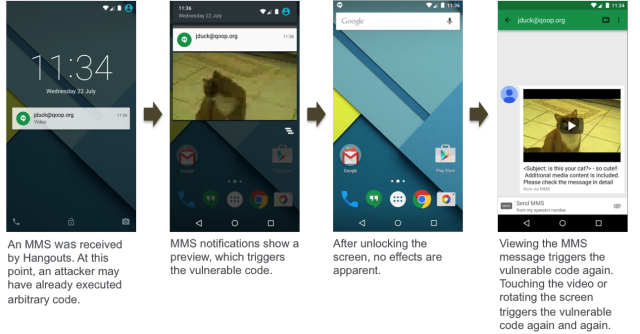
The most serious exploit scenario is the use of a specially modified text message using the multimedia message (MMS) format. All an attacker needs is the phone number of the vulnerable Android phone. From there, the malicious message will surreptitiously execute malicious code on the vulnerable device with no action required by the end user and no indication that anything is amiss.

The vulnerability can be exploited using other attack techniques, including luring targets to malicious websites. Drake will outline six or so additional techniques at next month's Black Hat security conference in Las Vegas, where he's scheduled to deliver a talk titled Stagefright: Scary Code in the Heart of Android.

Drake said all versions of Android after and including 2.2 are potentially vulnerable and that it's up to each device manufacturer to patch the bug. So far, very few devices have been patched, leading him to estimate that about 95 percent of devices—or about 950 million of them—are currently susceptible. Even Google's Nexus 5 handsets, which typically receive security fixes long before most other Android handsets—remain vulnerable. Nexus 6 devices, meanwhile, were patched only recently against some but not all Stagefright attacks.
 Vulnerable devices running Android versions prior to 4.3 (Jelly Bean) are at the greatest risk, since earlier Android versions lack some of the more recent exploit mitigations. Fixes require an over-the-air update.


Enter Firefox

Interestingly, the Stagefright vulnerability also affects Firefox on all platforms except Linux, and that includes the Firefox OS. Firefox developers have patched the vulnerability in versions 38 and up. 

"If you install Firefox 38, you can no longer get exploited directly via Firefox," Drake told Ars. "However, if I make your Firefox download the malicious video instead of trying to play it with a <video width="300" height="150"> tag, it will still reach the vulnerable Android code."

SilentCircle, maker of the Blackphone Android handset, has also patched the vulnerability in its PrivatOS with the release of version 1.1.7.

Android is designed with a security sandbox that prevents most apps from being able to access data used by other apps. That goes a long way to containing the damage Stagefright and similar code-execution exploits can do. In theory, for instance, it should prevent Stagefright exploits from sniffing login credentials used by a properly designed banking app. Still, Drake warned that successful exploits at the very least provide direct access to a phone's audio and camera feeds and to the external storage. Worse still, many older phones grant elevated system privileges to Stagefright code, a design that could allow attackers access to many more device resources.

"The attacker would have remote arbitrary code execution and thus escaping the sandbox is only a small step away," Drake said. He said existing root exploits, including those known PingPongRoot, Towelroot, and put_user, would likely help an attacker break free of the sandbox and gain much wider control over a vulnerable device.

For now, there's not much end users can do to protect themselves other than to install a patch as soon as one becomes available for their specific Android device. People can also prevent MMS messages from automatically loading in Google Hangouts or other text apps. That will prevent malicious code from being automatically loaded but won't protect against other attack vectors. There's no indication that the bug is being actively exploited in the wild. Google has thanked Drake for privately reporting the vulnerability and has since made a patch available to partners. But as we all know, it can take years for security fixes to reach some models, and many devices never receive them.

Post updated in the last paragraph to add sentences about turning off automatic loading of MMS messages.


Sunday, 26 July 2015

Ubuntu Phone is shipping, but it appears the software isn’t ready


Ubuntu phone
Ubuntu Phone


Over the last few years, Google and Android have increasingly dominated the mobile scene, with Microsoft relegated to bit-player status. Once-massive players like BlackBerry scarcely stir a ripple in the market.

Nonetheless, Ubuntu has chosen to stick its neck out and create a mobile operating system based on its own software to hopefully compete against the massive entrenched players. A new review of the Ubuntu Phone OS puts the operating system through its paces — and finds a great deal wanting.

Engadget has published a sizable review of Ubuntu Phone, and it’s worth reading in its entirety if you’re interested in an alternative operating system. The good news is that Ubuntu has nailed some interesting features on the device — the settings menu is well-crafted, the browser is nimble, and certain multitasking panels and multi-app display modes are well done.
 The company has created a set of content and service capabilities it calls “Scopes.” Scopes allow you to pick custom information feeds to scroll through and attempt to guess what content you want to see based on how you tell the phone you’re feeling. Tell it “I’m stressed,” and the phone will attempt to show results that might be pertinent.


Ubuntu Phone


Unfortunately, when it comes to many basic tasks and fundamental functions, Ubuntu Phone still falls short. According to the reviewer, the phone often freezes for significant periods of time, which Engadget believes is caused by the background updates to Scopes. The quad-core Cortex-A7 should be up to the task of handling the job, but it doesn’t seem to be. There are also significant issues regarding Ubuntu Phone’s touch sensitivity, its total lack of applications and reliance on web apps to make up the difference, and the operating system’s limited features and capabilities.

As Nick Summers, the reviewer, puts it: “Aside from the app void and the questionable value of Scopes, Ubuntu Phone is a bit of a nightmare to use the majority of the time… The gesture-based navigation is unrefined; there are bugs and glitches all over the place; and in general, many core experiences are severely lacking in polish. Despite years of development, Ubuntu Phone still feels like an early beta.”

I have deliberately skimmed the high points of the review, because it’s worth a read in full, but based on Summer’s reporting, I’d have to agree. In fact, I’d go one further and say I’m not certain there’s an actual market for Ubuntu Phone at all. Originally the OS was supposed to ship on ultra-low-cost devices, but with Android smartphones now dipping entry prices well below $100 in developing markets, I’m not sure there’s any need.

Obviously that won’t stop Ubuntu from investing in its project, but I can’t help wondering if Ubuntu Phone is Ubuntu’s Tizen — an underdeveloped platform with essentially no native applications and very limited prospects going forward. Samsung, at least, can guarantee that Tizen ships on devices by opting to use it on its own hardware. Ubuntu doesn’t have that option.


Friday, 24 July 2015

The Moto X 2014 is quick and capable after its Android 5.1 update

As its successor nears, the Moto X 2014 has a new lease on life with the Android 5.1 update

As its successor nears, the Moto X 2014 has a new lease on life with the Android 5.1 update
Though we all cheered when Motorola swiftly updated the Moto X 2014 to Lollipop soon after Android 5.0's release, it was immediately clear that the jump from KitKat introduced some issues. Choppy performance, a few quirky bugs and a generally unstable vibe came with the update, leaving owners feeling a bit burned.
 
When it came to making the next jump to Android 5.1, Motorola clearly took its time. The relatively small jump from 5.0 to 5.1 on the Moto X 2014 took longer to release than the substantially larger move from 4.4 to 5.0, but there was a reason — this update wasn't just a small version bump. It was a complete smoothing out of the Moto X's software experience. And as we approach the launch of a third-generation Moto X, the 2014 model is feeling peppy and capable thanks to the update.

Stability, speed and function


Moto X (2014)

It's clear to long-time Moto X (2014) users — myself included — that Motorola seriously improved the overall function of this phone with the Android 5.1 update. The experience went from unreliable, slow and often stuttery to smooth, quick and enjoyable, just like the experience we all had with the KitKat software that initially shipped on the phone.
 
Motorola addressed complaints, and then added extra features.

Some of the biggest complaints, like a constantly re-drawing and slow launcher, have been completely remedied in the update, while more subtle changes like improved app launch times and general smoothing of animations are also there. Motorola noted at least a dozen distinct bugfixes in the update changelog, and there's far more under the hood as well.

Of course we got the full suite of minimal changes in Android 5.1 like improved quick settings, which we expected to get. But Motorola also used this update to introduce several useful little features like the "chop chop" motion to turn on and off the flashlight, and subtle improvements to the way interruptions and downtime work.

The update hasn't improved the battery life — you can only do so much with 2300 mAh — but I wasn't exactly expecting that, either. If you've used a Moto X (2014) for some time you know the battery limitations, and you get on with your life. The same situation applies for the camera, though I have to say I've been snapping a few exceptional shots lately — and don't discount the fact that Motorola has regularly updated its Camera and Gallery apps in Google Play


A year old, and plenty of life left


Moto X (2014)

It's always a good sign when a phone that's nearing a year old still feels "modern" and capable compared to devices that are far newer, and it's just as reassuring when a software update provides that much of a boost in performance. You can only do so much with the software — as I mentioned in the battery and camera departments — but the most important parts of how you interact with the phone still somehow seem up to date since snagging the Android 5.1 download.

I'm sure the new version of the Moto X will make most people forget about picking up the previous model (save for some bargain hunters), but for those who stick with the one they have now, they at least still have a very quick, capable and powerful device in their hands thanks to Motorola's software update team.

Via- androidcentral

iPhone X vs Galaxy Note 8: Flagship Comparison

           Apple’s flagship iPhone X, priced at $999, is their most expensive smartphone yet, but one can get many of its features at a much...